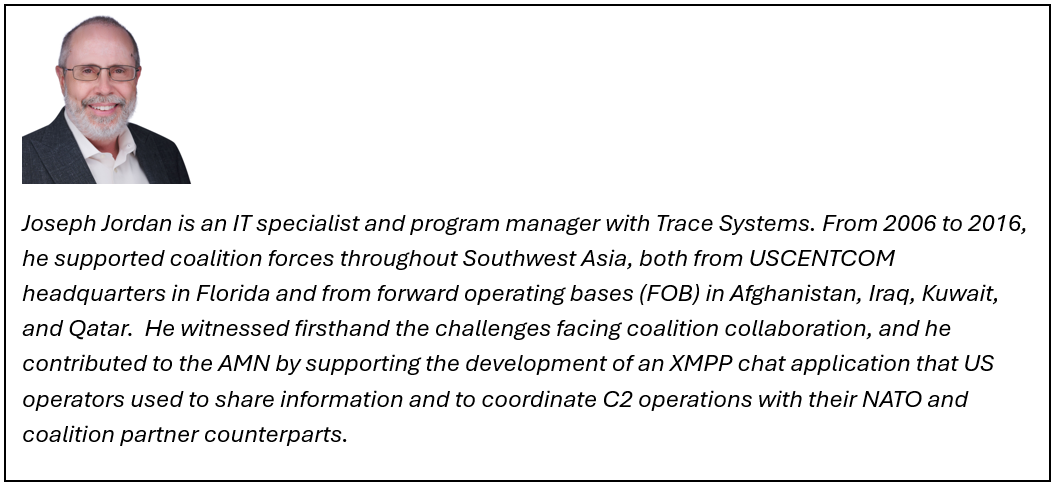
By Joseph Jordan, Senior Program Manager MPE and C5ISR
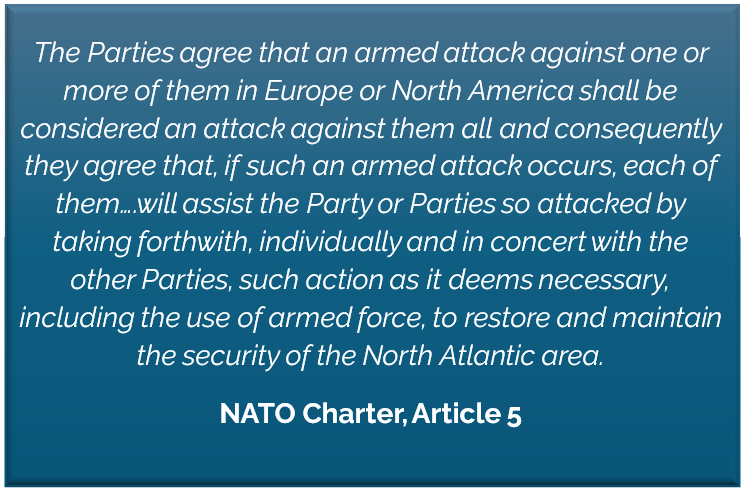
Less than a month after the September 11, 2001 attack by terrorists using commercial airplanes as weapons, the North Atlantic Treaty Organization (NATO) invoked Article 5 of its Charter in support of the United States (US).
It was the first and only time that Article 5 of the NATO Charter has ever been declared. However, throughout its history, the US has rarely gone into battle alone. From the Revolutionary War to the War on Terror, 80% of all military operations have involved allied nations fighting shoulder to shoulder. Those coalition operations all required effective communications across partner forces.
Following is a first-hand account of the challenges and successes in developing that communications network for recent major coalition endeavors in the US Central Command (USCENTCOM) area of operation.
Coalition Coordination in Real Time: A Practitioner’s View
In March of 2011 – while I was a defense contractor and systems administrator supporting USCENTCOM at its headquarters (HQ) on MacDill Air Force Base in Tampa, Florida – the US Africa Command (USAFRICOM) launched aircraft and missile strikes against the Muammar Gaddafi regime in Libya as part of Operation Odyssey Dawn. France and the United Kingdom participated in the attack to enforce United Nations (UN) Security Council Resolution 1973 in an attempt to protect civilians against government forces during the First Libyan Civil War.
At the time, my job was analyzing requirements and evaluating applications for installation on the Combined Enterprise Regional Information Exchange System (CENTRIXS), the US portion of the Afghanistan Mission Network (AMN) used by US, NATO, and other coalition partners for information sharing and command and control (C2) throughout Afghanistan and other parts of Southwest Asia (SWA).
By the end of March 2011, command of military operations against the Libyan government had transitioned to NATO under Operation Unified Protector, which included participation by non-NATO countries such as Jordan, Qatar, and the United Arab Emirates. During this transition, the military leadership where I worked at USCENTCOM HQ received requests for information (RFIs) about how we had created the AMN. There was no single C2 network shared by the various partners enjoined on Operation United Protector, and USAFRICOM sought lessons learned that would enable them to rapidly replicate the success of the AMN.
The AMN Challenge: Building a Network from Scratch
Addressing these RFIs proved challenging. The AMN had taken years to assemble and was still under development when the requests arrived. Creation of this expansive coalition network had required a considerable investment in hardware and software, numerous revisions to cybersecurity and cross-domain security practices, and many changes to national policies by all members who joined the AMN. It was not a resource that could be built from scratch easily or quickly.
The AMN concept was first endorsed in 2009 during Operation Enduring Freedom (OEF) by U.S. Army General Stanley A. McChrystal serving as Commander of International Security Assistance Force (ISAF) & U.S. Forces Afghanistan. Rather than relying on the historically stove piped and siloed network architectures for coalition coordination, a new purpose-built common network architecture separate from the US Secret Internet Protocol Router Network (SIPRNet), Global Counterterrorism Force (GCTF), ISAF-Secret, and NATO-Secret networks was needed.
General McChrystal sought a unified battlespace, aligned with his emphasis on joint, coalition, and intelligence-driven operations, which eventually culminated into creation of the AMN. The US, NATO, and other coalition partners took extraordinary measures to build this resource.
For five months in 2010, I participated in Task Force 236 (TF 236), a tiger team of IT contractors deployed by USCENTCOM across Afghanistan to develop the CENTRIXS infrastructure that would ultimately connect to the AMN. We were embedded with US Army signal officers on the ground, supporting Lieutenant General David Rodriguez – who had just become commander of the newly-formed ISAF Joint Command (IJC) – and his J6 leaders, Colonel Patrick Dedham, followed by Colonel Derek Orndorff. TF 236 installed network equipment, enterprise servers, virtualization environments, operating systems, and software applications at all the strategic bases and many of the tactical sites within Afghanistan. Together, military and industry, we faced the dangers of traveling to these locations and the logistical challenges of getting resources to the places they were needed, all to enable General McChrystal’s vision.
Slowly, and often painfully, the ambitious project progressed as each participating nation connected its own coalition spoke network to the ISAF-SECRET hub, creating the AMN and formulating a shared environment that matured from initial operational capability (IOC) to full operational capability (FOC) over the span of several years.
A New Operating Picture: Communications Across Coalitions
But this infrastructure was only part of the story. Modern warfare requires effective communications among coalition forces to coordinate C2, to deconflict the battlespace, and to avoid fratricide. The US and its partners needed a common operating picture (COP) on a common network environment, which is daunting enough among the individual service components within the Department of Defense (DoD), much less among allied nations. From 2006 and 2016, I witnessed the struggle firsthand, both from USCENTCOM headquarters in Florida and from forward operating bases (FOB) in Afghanistan, Iraq, Kuwait, and Qatar.
I contributed to this monumental effort by supporting the development of a chat application – based on the eXstensible Messaging and Presence Protocol – that US operators would use to share information and to coordinate C2 operations with their NATO and coalition partner counterparts. Chat was one of the core services offered on the AMN that utilized commercial off-the-shelf (COTS) products and technologies, making them quicker and easier to deploy than program of record COP applications such as Networked Interoperability Real-Time Information Service (NIRIS), Global Command and Control System (GCCS), and Joint Automated Deep Operations Coordination Systems (JADOCS).
While many applauded the ability of the AMN core services to expedite the projection of situational awareness to all stakeholders, up and down the chain of command and in geographically-dispersed locations, some commanders worried about delays and errors introduced when hand-jamming information from the official COP systems into disparate COTS platforms such as chat and email. I provided technical support to the AMN Coalition Interoperability Assurance and Validation (CIAV) working group in addressing these concerns and analyzing the effectiveness of the AMN core services in executing coalition mission threads.
Lessons Learned from the AMN Era
As a prototype for coalition networks, the AMN proved that such a capability could be achieved, despite its limitations. These limitations consisted of technical constraints such as latency issues, inconsistent bandwidth, and lack of software interoperability, as well as cultural and policy barriers that led to fragmented information sharing.
Above all, the time and money it took to complete the AMN highlights one of the fundamental challenges of creating a true, contingency coalition network. In the end, NATO and USAFRICOM resorted to using several networks to prosecute Operation Unified Protector over its seven-month duration, with liaison officers bridging releasable information to non-NATO members of the coalition.
Lessons learned from the AMN have led to numerous efforts over the past decade to overcome these challenges and to build a coalition environment that could be turned on at a moment’s notice as hostilities unfold. These innovations include the Future Mission Network (FMN)1, the Mission Partner Environment (MPE)2, the long-discussed Secret and Below Releasable Environment (SABRE)3, and now the Mission Network as-a-Service (MNaaS)4, as well as efforts spearheaded directly by DoD combatant commands to include the CENTCOM Collaborative Partner Environment (CPE)5 and the US Indo-Pacific Command (INDOPACOM) INDOPACOM Mission Network (IMN)6.
The Future of Coalition Networks
As the DoD shifts from network-centric silos to a data-centric architecture under its Combined Joint All-Domain Command and Control (CJADC2)7 vision, the focus of coalition communications is moving towards technologies that will enable multi-enclave client (MEC)8 access through policy-based methodologies, such as metadata tags and user attributes, rather than relying on the physical connection of national networks through firewalls and cross-domain solutions. Technology advances in Attribute-Based Access Control (ABAC), Identity, Credential, and Access Management (ICAM), and other zero-trust methodologies9 will one day lead to the Holy Grail of fully integrated coalition COP. This capability has already been tested with industry engagement during Risk Reduction Events at the Joint Modernization Command (JMC)10 and through numerous exercises such as Talisman Sabre 202311 and Yama Sakura 8512.
Until that day, however, immediate dangers lurk across the globe for the US and our allied partners. One notable scenario could be countering the Peoples Republic of China’s expansionist ambitions within the East and South China Seas. Such an operation would not only include allies with whom we have mature communication and data networks, such as Five Eyes (FVEY) network environments with Australia and bilateral networks with Japan (CENTRIXS-J) and South Korea (CENTRIXS-K). Undoubtedly, we would find ourselves coordinating missions with allies such as Vietnam and the Philippines, with whom we currently have no shared network environments.
The Challenge: Imperative of Interoperability
How would we coordinate C2, deconflict the battlespace, and avoid fratricide when events unfold as fast as they did during Operation Odyssey Dawn, but with an adversary that is much more powerful and capable? Without a technical and policy compliant solution that provides a true contingency “out of the box” coalition network, the risk of mission failure remains high.
Experience has proven that essential services can be delivered quickly and securely using today’s network infrastructure. Modern technologies now allow bilateral and multinational environments to be stood up in hours, not years, and at a fraction of the historical cost. Rather than waiting on protracted acquisition cycles, the Department of Defense and its partners can tap into solutions already tested and available, ensuring coalition communications are ready the moment they’re needed.
In summary, while America is the preeminent superpower in the world today, with the most powerful and versatile military in the history of humankind, we rarely go into battle alone. I believe the lessons of the AMN are clear. We need rapidly deployable, adaptable coalition networks, and the need is more critical now than ever. As global complexities mount, the ability to instantly establish secure, effective communication channels with diverse partners will not just be an advantage – it will be essential to achieving success in future conflicts, ensuring that when the moment demands immediate action, our military and those of our allied partners can truly operate as one unified force.
Citations:
- C2CoE AFGHANISTAN MISSION NETWORK / FUTURE MISSION NETWORK STUDY, May 31, 2012. https://c2coe.org/download/afghanistan-mission-network-future-mission-network/
- DoD Instruction 8110.01, June 30, 2021 https://www.esd.whs.mil/portals/54/documents/dd/issuances/dodi/811001p.pdf
- Mission Partner Environment Cuts Decision Making, Kill Chain, November 29, 2021 https://www.defense.gov/News/News-Stories/Article/Article/2854238/mission-partner-environment-cuts-decision-making-kill-chain/
- Arrington Teases DoD ‘Mission Network as a Service’ Program, MeriTalk, June 11, 2025 https://www.meritalk.com/articles/arrington-teases-dod-mission-network-as-a-service-program/
- Collaborative Partner Environment (CPE) AFCEA Conference, August 17, 2022 https://events.afcea.org/Augusta22/Custom/Handout/Speaker0_Session9673_1.pdf?
- INDOPACOM is replacing a pile of partner-nation networks with just one, Defense One, November, 18, 2024 https://www.defenseone.com/defense-systems/2024/11/indopacom-replacing-pile-partner-nation-networks-just-one/401129/?
- CDAO Initiatives: CJADC2, https://www.ai.mil/Initiatives/CJADC2/
- USINDOPACOM Mission Partner Environment Success: A Blueprint for CJADC Path Forward, Federal News Network, June 18, 2024 https://federalnewsnetwork.com/commentary/2024/06/usindopacom-mission-partner-environment-success-a-blueprint-for-cjadc2-path-forward/?
- Zero Trust: Enabling Partnerships for a Warfighting Decision Advantage, October 22, 2024, https://events.afcea.org/TIP24/Custom/Handout/Speaker0_Session11343_1.pdf?
- As next step in modernization experimentation, Project Convergence adds multinational partners to Mission Partner Environment, March 11, 2022 https://www.army.mil/article/254617/as_next_step_in_modernization_experimentation_project_convergence_adds_multinational_partners_to_mission_partner_environment
- Talisman Sabre 23 increases network capabilities with partner nations, August 23, 2023 https://www.army.mil/article/269313/talisman_sabre_23_increases_network_capabilities_with_partner_nations#:~:text=Talisman%20Sabre%20is%20a%20large,Credit:%20U.S.%20Army)%20VIEW%20ORIGINAL
- I Corps and allies demonstrate joint force readiness during Yama Sakura 85, December 12, 2023 https://www.army.mil/article/272369/i_corps_and_allies_demonstrate_joint_force_readiness_during_yama_sakura_85